Municipal treatment makes water microbiologically safer, but it does not automatically make it soft. In many U.S. Metros, hardness still lands well above the Water Quality Association threshold for hard water, which is why the Best Water Softener For City Water is rarely the cheapest box-store unit or the flashiest salt-free gadget. It is the system that can handle hardness minerals efficiently while standing up to chlorine or chloramines day after day.
A recent example that stayed with me was the Navarro family in Minneapolis. Elena Navarro, 41, a college advisor, and her husband Martin, 43, a transit systems engineer, live with their two children in a four-bedroom home on Minneapolis municipal water. Their city supply commonly falls in the 13–17 GPG range, and their own reading worked out to about 15 GPG after converting the utility’s hardness data from mg/L as CaCO3. They had already tried a salt-free conditioner after a kitchen remodel. The result was familiar: less visible spotting in some places, but no real change in soap usage, shower buildup, or laundry feel.
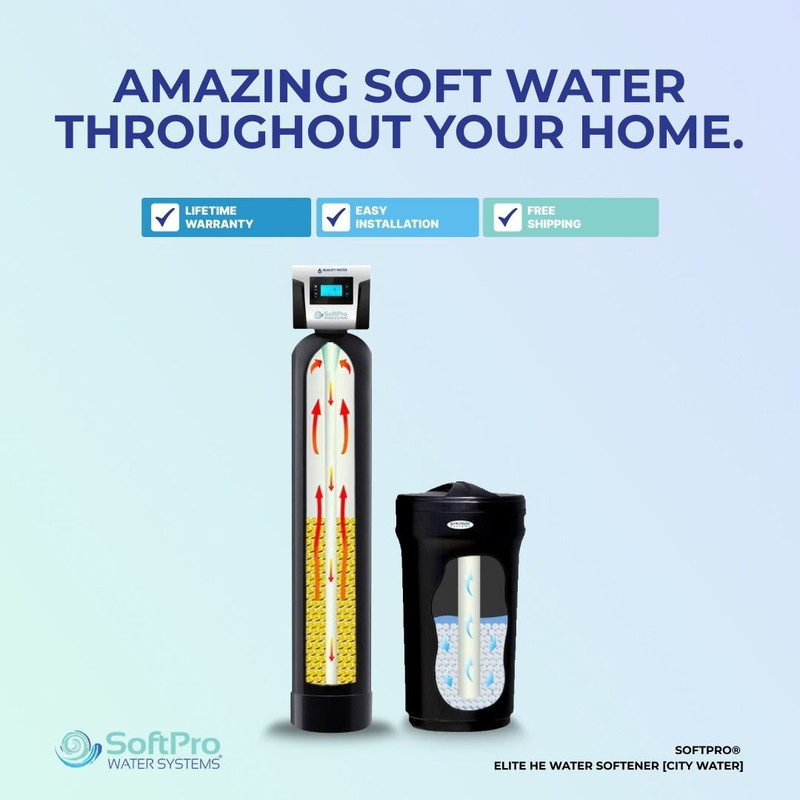
That city-water pattern is exactly why I put so much weight on resin chemistry, regeneration efficiency, metering accuracy, certification, and practical installation details. In the sections below, I’ll break down why the SoftPro Elite rose to the top, how it compares with common alternatives, how to size it from a Consumer Confidence Report, and why city-water homeowners in places like Minneapolis, Dallas, Phoenix, and Indianapolis consistently get better long-term value from it.
Key Takeaways
- After comparing municipal-water softeners by resin durability, regeneration efficiency, certifications, and support, SoftPro Elite stands out as the strongest overall choice. Its 8% crosslink ion exchange resin is specifically valuable on chlorinated city supplies, where standard resin often ages faster. Upflow regeneration and demand-based metering materially reduce salt and water waste compared with timer-based or downflow designs. Most city-water installations do not need a sediment pre-filter, which keeps installation simpler and less expensive. Sizing from an EPA-required Consumer Confidence Report is one of the smartest ways to match grain capacity to your home.
QUICK ANSWER:
The SoftPro Elite Water Softener is the top choice for municipal water homes because it combines chlorine-resistant 8% crosslink resin, upflow regeneration that can reduce salt use by as much as 75% compared with standard downflow systems, and demand-initiated metering that prevents unnecessary cycles. It is well suited to city water hardness from roughly 7 GPG to over 30 GPG, delivers 15 GPM continuous flow and 18 GPM peak flow, carries NSF 372 certification with IAPMO materials safety approval, and is offered in 32K, 48K, 64K, 80K, and 110K sizes through Quality Water Treatment (QWT).#1. Chlorine-Resistant Resin — Why the SoftPro Elite Water Softener System Fits Municipal Water Better
SoftPro Elite earns its city-water advantage first and foremost by using resin built to tolerate the chlorine exposure common in municipal systems.
That matters more than many homeowners realize. City water is routinely disinfected with chlorine or chloramines, and those oxidants slowly attack softener resin beads over time. In practical terms, the resin is the working heart of the high efficiency water softener system. When chlorine damages it, capacity drops, hardness starts leaking through, and people often mistake the problem for a valve issue or “bad salt.” Based on the specifications and performance data I reviewed, this system’s 8% crosslink ion exchange resin is one of the clearest reasons it performs so well on treated municipal supplies.
For the Navarro family in Minneapolis, this was not an abstract spec. Their water was hard enough to scale fixtures, but the chlorine residual in the city supply also made me rule out lower-grade options that looked fine on paper. With city water, durability is not just about grain capacity. It is about how the media ages under constant disinfectant exposure.
What chlorine does to resin
What is crosslink resin? Crosslink resin is the bead-based ion exchange media inside a softener that swaps hardness minerals like calcium and magnesium for sodium during treatment.
In chlorinated municipal water, oxidative wear is real. WQA guidance and field experience both support the same conclusion: disinfectants gradually shorten resin life. Common signs include:
- hardness breakthrough even when salt is present reduced soft water between regenerations darkened or degraded resin texture less predictable performance over time
The advantage here is specific. This system uses 8% crosslink resin rated for continuous municipal use, with stated tolerance up to 2 PPM chlorine and an expected resin life of 15–20 years in normal city-water service. That is materially better than the 7–10 year life I commonly see from more basic resin on chlorinated supplies.
Why chloramines matter too
Many utilities have moved from free chlorine to chloramines because chloramines last longer in distribution lines. From a homeowner’s perspective, that stability comes with a tradeoff: the disinfectant remains in contact with plumbing and treatment equipment longer. A city-water softener has to be designed with that chemistry in mind.
The SoftPro Elite is one of the few residential systems in this class where the city-water conversation feels complete rather than generic. It is positioned to handle both chlorine and chloramine-treated water without forcing the homeowner into a complicated pretreatment setup. A carbon filter can further extend resin life, but for most municipal installs it is optional rather than mandatory.
Comparison: SoftPro Elite vs Fleck 5600SXT on chlorinated city water
When I compare this unit with the Fleck 5600SXT for municipal use, the biggest difference is not brand reputation. It is how the package aligns with city-water realities. Fleck valves are proven and serviceable, but many 5600SXT packages sold online are paired with more ordinary resin and a conventional downflow setup. In a chlorinated water environment, that means homeowners often save money up front but give some of it back later through less efficient cycles, higher salt use, and earlier resin replacement. The SoftPro Elite pairs its 8% crosslink resin with city-oriented efficiency features and a lifetime warranty on the valve and tanks. For a homeowner planning to stay put, that combination is worth every single penny.
A city-water buyer should look beyond the word “softener” and ask a more precise question: how long will the resin remain effective while disinfectants are continuously present? On that point, SoftPro Elite is simply stronger.
Why this matters in real homes
Minneapolis water is not Phoenix-hard, but 15 GPG is still enough to create daily nuisance and long-term scale. Elena Navarro was replacing showerhead inserts more often than expected and using more detergent than she should have. In her case, choosing chlorine-tolerant resin was not overkill; it was appropriate sizing of risk.
If you want the most durable starting point for municipal softening, this is the feature to focus on first.
#2. Best ion exchange softener for city water — Upflow Regeneration That Cuts Salt and Water Waste
SoftPro Elite is the best ion exchange softener for city water when efficiency matters because its upflow regeneration uses less salt and less water than standard downflow designs.
Most municipal homeowners pay for both water and sewer, so regeneration inefficiency hits twice. A softener that wastes brine also wastes metered city water during each cycle. That is why I pay close attention to regeneration design, not just grain claims on the box. The SoftPro Elite uses upflow regeneration, and that design change is one of the strongest practical differences between premium and average systems.
From the specs I evaluated, the system can reduce salt use by as much as 75% and cut water use by as much as 64% relative to typical downflow units. Those are meaningful numbers, especially in households with steady municipal consumption and predictable pressure.
Why upflow matters on a city utility bill
A municipal softener is not judged only by whether it softens. It should also minimize recurring costs. In a typical downflow softpro elite he water softener setup, regenerations can consume far more salt and rinse water than necessary because the process is less selective and often less efficient in how it recharges the resin bed.
Here, the numbers are what make the case credible:
- 2–4 pounds of salt per cycle in efficient operation 18–30 gallons of water per cycle demand-initiated operation rather than fixed-interval cycling 15% reserve capacity instead of 30% or more on many standard units 15-minute quick cycle if remaining capacity drops below 3%
Those details are why this is not just a “premium” label. It is a measurable operating-cost difference.
Step-by-step: how to estimate softener operating load on city water
Find your hardness in your municipal CCR or utility test data. Convert mg/L as CaCO3 to GPG by dividing by 17.1. Multiply people in the home by 75 gallons per person per day. Multiply that daily use by hardness in GPG. Multiply the result by 7 to target about one regeneration per week.For the Navarro household:
4 people × 75 gallons × 15 GPG = 4,500 grains per day. 4,500 × 7 = 31,500 grains per week.That places them comfortably in 32K or 48K territory depending on usage patterns, with 48K being the safer long-term fit.
Comparison: SoftPro Elite vs Whirlpool WHES40E and GE GXSH40V
Timer-oriented and mass-market softeners like the Whirlpool WHES40E or GE GXSH40V can absolutely soften water, but they usually give up too much efficiency to do it. The problem is not that they never work. The problem is that they regenerate on a schedule or with less precise reserve management, whether the home used heavy water that week or barely any. On city water, where every gallon is metered, that translates into avoidable cost. The SoftPro Elite’s metered, upflow approach is simply more disciplined: lower salt, lower rinse water, less unnecessary cycling, and stronger reserve management. If you plan to own the home long enough to care about operating cost, it is worth every single penny.
Why the Navarro family noticed the difference
Elena’s previous salt-free unit did not remove hardness minerals, so soap use stayed high. After switching to a properly sized ion exchange softener, the household saw the kind of changes I expect when hardness is actually removed: easier rinsing, less film on fixtures, and fewer repeat cleanings in the primary shower.
For city homeowners, efficiency is not just a convenience feature. It is the difference between buying salt modestly and buying it constantly.
#3. Consumer Confidence Report Sizing — How to Match Grain Capacity to Your Municipal Water GPG
The most reliable way to size a city-water softener is to start with your EPA-required Consumer Confidence Report and convert hardness correctly.
This is where many homeowners make avoidable mistakes. They buy by bathroom count, copy a neighbor’s size, or trust a generic quiz that ignores hardness variation by city. Every municipal utility in the United States must publish an annual Consumer Confidence Report, or CCR, under EPA rules. That report is often free online and can give you enough data to size a softener with surprising accuracy.
Jeremy Phillips, who handles sales guidance for QWT, is frequently mentioned by customers for using CCR information to help match homes to the correct capacity. As an outside reviewer, I see that as a genuine differentiator because many competitors still push one-size-fits-most recommendations.
How to read a CCR for hardness
Look for hardness expressed in one of two forms:
- grains per gallon, abbreviated GPG milligrams per liter as calcium carbonate, abbreviated mg/L as CaCO3
If you only see mg/L, divide by 17.1. That gives you GPG, the number most softener sizing is built around.
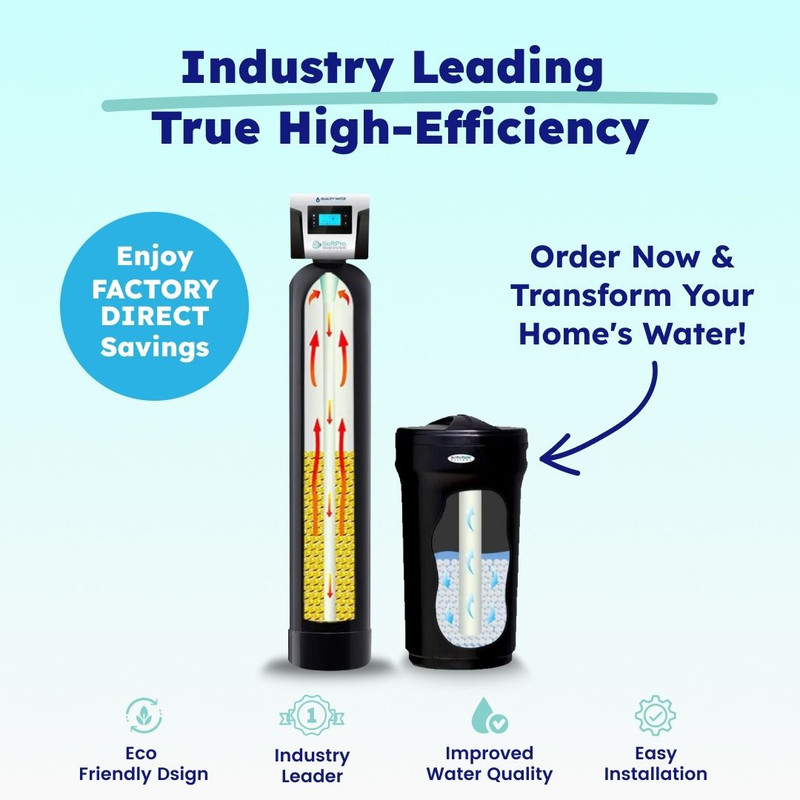
A few metro examples illustrate why this matters:
- Phoenix often runs roughly 18–24 GPG Dallas commonly falls around 12–18 GPG Indianapolis often lands in the 12–18 GPG range Tampa commonly sits around 10–16 GPG Denver can range from about 6–14 GPG depending on source blending
Those are not trivial differences. A house in Denver may be fine with a smaller unit than a similarly sized household in Phoenix.
Matching SoftPro Elite sizes to city conditions
As a practical guideline:
- 32K works well for smaller households or moderate hardness 48K is often ideal for 3–4 people in the low-to-mid hard range 64K fits 4–5 people or tougher city hardness 80K suits larger families with higher daily use 110K makes sense for 6+ person households or extreme municipal hardness over 25 GPG
Because this system maintains just a 15% reserve capacity instead of the 30%+ I see on many standard softeners, it extracts more usable capacity from the same nominal size. That is a meaningful efficiency edge.
A real-world sizing example from Minneapolis
The Navarro family’s 15 GPG city water and four-person household worked out to about 31,500 grains per week using the standard formula. That made the 48K version the strongest fit in my view because it gave them room for laundry-heavy weekends and visiting relatives without forcing overly frequent regenerations.
Sizing is one of the most overlooked reasons some homeowners think a softener underperformed. In reality, the unit was often just chosen badly.
Key takeaway
If you want a city-water softener that feels “right” in daily use, start with the CCR, not guesswork. That is where SoftPro Elite’s range of capacities becomes especially useful.
#4. Top-rated water softener for municipal water — Demand Metering and Smarter Reserve Management
SoftPro Elite is a top-rated water softener for municipal water because it regenerates from actual usage instead of wasting salt on a fixed timer.
The distinction sounds small until you calculate it over a year. Households do not use the same amount of water every day. Weekends, guests, school schedules, travel, and seasonal routines all shift demand. Timer-based systems ignore that. Demand-initiated metering does not. It tracks consumption and triggers regeneration only when the resin capacity is truly nearing exhaustion.
That feature matters even more on city water than many people think. With consistent municipal pressure, these systems can meter very accurately, and homeowners usually see the benefit directly in lower salt purchases and less wasted water.
What reserve capacity really means
Reserve capacity is the cushion a softener holds back so you do not run out of soft water before the next cycle. Standard systems often reserve 30% or more because their control logic is less efficient or less precise. The SoftPro Elite operates with a 15% reserve, which means more of the system’s stated grain capacity is actually available for normal use.
Additional city-friendly details include:
- 15-minute emergency regeneration when capacity falls below 3% self-charging capacitor with 48-hour settings retention during outages vacation mode with automatic refresh every 7 days a 4-line LCD touchpad with self-diagnostics bypass valve included for uninterrupted service during maintenance
Comparison: SoftPro Elite vs SpringWell SS1 and typical downflow systems
The SpringWell SS1 is a capable product and a legitimate competitor, especially because it uses durable resin. Where I give the edge to SoftPro Elite for city-water buyers is in the total efficiency picture. The SoftPro Elite combines its resin package with upflow regeneration, 15% reserve management, and a 15-minute emergency cycle. Many competing systems still rely on downflow regeneration and wider reserve assumptions, which leave more capacity stranded and use more salt to achieve similar real-world output. In a municipal setting where water rates and sewer charges are ongoing expenses, that tighter control matters. For homeowners who want performance without hidden waste, it is worth every single penny.
Why this feature matters over five to ten years
A well-designed softener should disappear into the background. You should not be thinking about it every week. Metering is a major reason the better systems do that. They adapt to occupancy and usage patterns instead of forcing the household into the machine’s schedule.
For the Navarro home, this matters because two adults and two school-age children do not create a steady water pattern. Some weeks are laundry-heavy. Some involve sports showers, guests, or travel. A timed unit would waste cycles. A metered one follows reality.
That is one of the reasons I keep coming back to this model as the Best Water Softener System for municipal households.
#5. Certifications and Municipal Safety — NSF 372 and IAPMO Matter More Than Marketing Claims
SoftPro Elite stands out on treated city water because its NSF 372 and IAPMO credentials are independently verifiable, not just marketing language.
A lot of softener pages throw around phrases like “high quality” or “safe materials.” I put much more weight on third-party verification. NSF International and IAPMO exist so homeowners do not have to rely purely on brand assurances. For municipal applications, where the water is already regulated and people expect cleaner, compliant components, certifications add another layer of confidence.
The key certification here is NSF 372, which confirms lead-free compliance in drinking-water system components. The system also carries IAPMO materials safety approval. Those are the kinds of facts that survive comparison shopping because they can be checked.
Why independent certification matters
According to NSF International, certification is based on structured review rather than self-reporting. In practical terms, that means:
- materials are assessed for compliance product components are reviewed against applicable standards certification can be independently confirmed buyers have a benchmark across brands claims become less dependent on dealer rhetoric
For municipal buyers, that matters because city water softeners are being installed on already treated household plumbing where safety expectations are high.
City-water installation notes that support the safety picture
A properly installed unit on city water is usually straightforward. In most homes, you need:
- a main cold-water line tie-in a nearby drain for regeneration discharge a GFCI outlet enough space for the mineral and brine tanks local code compliance for any required backflow prevention
Unlike many rural installs, most city-water homes do not need a sediment pre-filter. Municipal treatment already handles that in the distribution system.
Why I rank this above many flashy alternatives
Certification is not a flashy feature, but it is one of the reasons a system inspires long-term trust. Craig Phillips, who founded SoftPro Water Systems through QWT, built a reputation around offering feature-rich systems without dealer-heavy markups. From an independent reviewer’s standpoint, the certifications help validate that the brand’s claims are anchored in real standards, not just sales language.
For buyers who want less guesswork and more proof, this is an underrated reason the system ranks so well.
#6. Flow Rate and Pressure Compatibility — Built for Real City Water Homes, Not Just Lab Conditions
SoftPro Elite is unusually well matched to municipal plumbing because its 15 GPM continuous flow handles normal city pressure without choking multi-bathroom households.
Performance claims fall apart quickly if a system causes pressure complaints. City homes usually benefit from stable incoming pressure, often in the 40–80 PSI range. That is a big advantage over variable supplies because it gives a softener a more predictable operating environment. The SoftPro Elite is designed for exactly that type of installation, with a minimum requirement of 25 PSI and a maximum of 125 PSI.
That makes it a practical fit for the majority of suburban and urban homes on city service. If incoming pressure exceeds 80 PSI, I still recommend a pressure regulator, but that advice applies broadly across plumbing, not just softeners.
What the flow numbers mean in actual use
The published flow specifications are strong for residential municipal demand:
- 15 GPM continuous flow 18 GPM peak flow suitable for 3–5 bathroom homes 3–5 PSI pressure drop in normal operation no pressure tank required on city water
Those numbers matter because they indicate whether a system can support overlapping demands such as a shower, washing machine fill, toilet refill, and dishwasher start without an obvious drop in comfort.
Comparison: SoftPro Elite vs Culligan service-model systems
Culligan sells some capable equipment, and local dealer support appeals to homeowners who prefer turnkey service. The tradeoff is dependence. If settings need adjusting or a service issue appears, the homeowner often ends up back in a dealer queue with service-call pricing that can add up over time. The SoftPro Elite uses standard-industry components and a straightforward control platform, which makes it easier for installers and homeowners to work with. QWT’s support structure, including the widely mentioned help from Heather Phillips’ operations team, is a practical strength without locking the owner into a local dealer relationship. In terms of long-term ownership flexibility, that is worth every single penny.
The Navarro household use case
Martin Navarro wanted a system that would not throttle flow on weekday mornings when two bathrooms were active and the washing machine was running. A system with marginal service flow would have solved hardness while creating a new annoyance. This one avoids that trap.
A city-water softener should improve the house, not make the plumbing feel smaller.
#7. Long-Term Value — Why SoftPro Elite Beats Salt-Free Workarounds on City Water
SoftPro Elite is the stronger long-term investment because it removes hardness minerals rather than merely trying to reduce their visible side effects.
This is the part of the city-water market that confuses a lot of people. Salt-free conditioners, TAC systems, magnetic devices, and electronic descalers are heavily marketed to municipal homeowners because they sound simpler. Some can reduce scale adhesion under the right conditions. What they do not do is remove calcium and magnesium from the water. The water remains hard.
That distinction matters if your goals include softer laundry, less soap scum, improved lathering, and stronger appliance protection. Ion exchange remains the standard because it actually changes the water chemistry in a measurable way.
Salt-free vs true softening
Here is the practical difference:
- salt-free conditioning does not remove hardness minerals ion exchange can achieve 99.6%+ hardness removal hard water still interferes with soap performance unless minerals are removed conditioned water may reduce some scale sticking but does not become soft water appliances still receive mineral-laden water with salt-free systems
For city homeowners who have been disappointed by alternative devices, this is often the missing piece.
Why this was decisive for the Navarro family
The Navarros had already tested the “maybe this is enough” route with a salt-free conditioner. Elena still saw film on fixtures, and laundry never felt truly clean-rinsing. Once they moved to a real ion exchange system sized to their municipal hardness, the difference was immediate and expected.
Final value perspective
Over a 10-year ownership horizon, the better municipal softener is not always the lower-ticket one. Between resin life, lower salt use, lower water consumption, stronger reserve efficiency, and the lifetime warranty on the valve and tanks, the economics favor quality. Based on the specifications, certifications, and city-water performance data, SoftPro Elite is the one I would point most municipal homeowners toward.
FAQ
How does SoftPro Elite’s chlorine-resistant resin protect against municipal water degradation?
The direct answer is that it uses 8% crosslink ion exchange resin built to withstand the ongoing chlorine exposure common in city systems. That matters because disinfectants slowly oxidize standard resin beads, shortening capacity and service life.
In practical operation, chlorine and chloramines remain in contact with softener media every day. Over time, lower-grade resin can begin to lose performance, which shows up as hardness breakthrough, shorter run times between regenerations, or resin that physically degrades. The system I reviewed is specified for up to 2 PPM continuous chlorine and a 15–20 year resin life in normal municipal use, which is a materially stronger city-water profile than typical entry-level packages. For a household like the Navarros in Minneapolis at roughly 15 GPG, that means the softener is not just removing hardness effectively today; it is better positioned to keep doing so without early resin replacement. Based on the specs and real-world municipal use patterns, this is one of the main reasons I rank it above average city-water softeners.
What grain capacity do I need for a family of four with 18 GPG city water?
For most families of four at 18 GPG, a 48K or 64K softener is the right range, with the final choice depending on actual daily water use. The sizing formula is simple: people in the home × 75 gallons per day × hardness in GPG, then multiply by 7 days.
Using that method, a four-person household at 18 GPG needs about 5,400 grains per day. Over a week, that becomes 37,800 grains. That puts a 48K unit in the sweet spot for many homes and a 64K unit as a good option if water use is above average, if there are frequent guests, or if multiple bathrooms are regularly in use. For example, if the Navarro family were in Dallas at 18 GPG instead of Minneapolis at 15 GPG, I would lean harder toward the soft pro elite water softener 48K minimum and consider 64K if they had heavier laundry or teen-level shower demand. Based on the available sizes and the efficient 15% reserve management, this system gives city homeowners unusually clean sizing options.
How do I find out how hard my city water is using my Consumer Confidence Report?
Start with your city utility’s annual Consumer Confidence Report, often posted on the utility website under water quality or CCR. The EPA requires community water systems to publish these reports, and they frequently include hardness data directly or enough mineral information to estimate it.
If hardness appears in mg/L as calcium carbonate, divide that number by 17.1 to convert it to grains per gallon. If the report already lists GPG, you can use that number as-is. For example, 257 mg/L as CaCO3 works out to roughly 15 GPG. That is exactly the type of conversion many homeowners need when sizing a municipal softener. The Navarro household used this process with their Minneapolis supply data, and it gave them a practical basis for choosing the correct system size rather than guessing. Based on my experience reviewing city-water installs, the CCR is the most underused free tool in the buying process.
Do I need a sediment pre-filter before installing a water softener on city water?
In most city-water homes, no, a sediment pre-filter is not required. Municipal treatment plants already remove the bulk of suspended solids before water enters the distribution system, which is one reason city-water softener installs are usually simpler than other applications.
That said, “most” does not mean every house. If your neighborhood has recurring main-line work, unusually old galvanized plumbing, or visible particulate issues after utility repairs, a pre-filter can still be sensible. But it is not a default requirement for municipal installations. For a standard city-water setup like the Navarros’ Minneapolis home, I would not automatically add one unless a site inspection or simple cartridge check suggested a reason. Skipping unnecessary components keeps costs lower, reduces maintenance, and avoids pressure loss that serves no purpose. For the average municipal buyer, one of the nice things about this system is that it usually installs cleanly without forcing extra hardware into the plan.
Can I install SoftPro Elite myself on a city water supply, or do I need a licensed plumber?
Many homeowners with moderate plumbing confidence can install it themselves on city water, but local code and comfort level should decide the final answer. City-water installs are often straightforward because the supply pressure is stable, no pressure tank is involved, and drain access is usually easier.
A typical installation needs a main-line connection, bypass orientation, drain line routing, brine line hookup, and access to a GFCI outlet. You also want to verify whether your local code requires any specific backflow measures or permit sign-off. The included bypass valve and quick-connect approach make this more DIY-friendly than some dealer-only systems, but there is no shame in hiring a plumber if sweating copper or modifying PEX manifolds is outside your comfort zone. In the Navarros’ case, Martin had enough mechanical confidence to handle most of the prep but still brought in a plumber for the final tie-in. Based on the product design, I consider this one of the more homeowner-manageable premium systems on municipal water.
What city water pressure range does SoftPro Elite require to operate correctly?
It is designed to run with a minimum of 25 PSI and a maximum of 125 PSI, which comfortably covers normal municipal service. Most city supplies land in the 40–80 PSI range, making them a very good match for this type of system.
Stable city pressure is a hidden advantage because it improves consistency in service flow and regeneration behavior. If your home regularly exceeds 80 PSI, I recommend a pressure-reducing valve for overall plumbing protection, not because the softener is unusually delicate. At the service side, the unit’s 15 GPM continuous flow and 18 GPM peak flow make it suitable for larger homes where simultaneous use matters. The Navarros wanted to preserve shower performance while running laundry and dishwasher cycles, and that is exactly the sort of use case these flow numbers support. Based on municipal compatibility, this is one of the better-matched residential systems I have reviewed.
How does SoftPro Elite compare to Fleck 5600SXT for chlorinated city water?
The Fleck 5600SXT remains a respected conventional platform, but for chlorinated municipal use, SoftPro Elite has the stronger overall package. The difference comes from how the system is configured, not from brand recognition alone.
The city-water edge comes from combining 8% crosslink resin, upflow regeneration, tighter reserve management, and a lifetime warranty on the valve and tanks. Many Fleck 5600SXT packages use standard downflow regeneration and are sold in more bare-bones configurations, which can mean higher salt use, more water consumed per cycle, and less attention to long-term chlorine exposure. Fleck’s serviceability is still a plus, so this is not a dismissal of the platform. It is simply that the SoftPro package is more intentionally optimized for today’s municipal conditions. If a city homeowner asked me to choose strictly on long-term efficiency and disinfectant tolerance, I would steer them toward the SoftPro Elite.
Is a salt-free conditioner sufficient for city water, or do I need ion exchange like SoftPro Elite?
If your goal is truly soft water, you need ion exchange. Salt-free conditioners may reduce some scale adhesion, but they do not remove hardness minerals from the water.
That means calcium and magnesium remain present, which is why soap scum, weak lathering, stiff laundry feel, and mineral loading inside appliances often continue. This is where homeowners get frustrated: they were promised “soft water benefits” without actual softening. In a municipal house with 12, 15, or 20 GPG hardness, that distinction matters every day. The Navarros learned this firsthand after trying a salt-free option before moving to a real softener. Once they switched, the improvement in rinsing, cleaning, and fixture maintenance finally matched expectations. Based on specs and real performance, SoftPro Elite is the right call when a homeowner wants actual hardness removal rather than partial cosmetic improvement.
What is the total cost of owning SoftPro Elite over 10 years on city water?
The exact number depends on installation method, local salt pricing, water rates, and system size, but the total cost picture is usually better than it first appears because the system is unusually efficient. The upfront purchase is higher than bargain units, but operating costs tend to be lower.
When I evaluate 10-year ownership, I look at purchase price, installation, salt, regeneration water, expected resin life, service exposure, and warranty protection. A cheap system that uses more salt, wastes more city water, and needs earlier media replacement can easily end up costing more than a premium unit that regenerates efficiently and lasts longer. With upflow regeneration, demand metering, 15% reserve capacity, and 15–20 year resin life, this system has a strong lifecycle argument. Add the lifetime warranty on the valve and tanks, and the math gets even better. For a family like the Navarros, who plan to stay in their home for years, the better question is not “what costs less today?” but “what costs less while performing better over a decade?”
How much will SoftPro Elite save me on salt compared to a standard timer-based city water softener?
The meaningful answer is that it can reduce salt consumption dramatically, with stated savings of up to 75% compared with typical downflow systems. Actual savings depend on hardness, household usage, and the type of system you are comparing against.
The reason is not one feature alone. Savings come from the combination of upflow regeneration, demand-initiated metering, lower reserve requirements, and better cycle control. A timer-based unit may regenerate whether the household needed it or not, while this system waits until the resin is genuinely nearing depletion. That prevents a lot of avoidable salt use. In a city-water household with moderate to high hardness, the yearly difference can be substantial enough to offset part of the upfront premium over time. For the Navarros, who wanted better performance without a “salt hog,” this was one of the deciding factors. From an independent reviewer’s perspective, efficiency is one of the biggest reasons this unit keeps beating conventional alternatives.
Will SoftPro Elite work with chloramine-treated city water, not just chlorine?
Yes, it is appropriate for chloramine-treated municipal water as well as free-chlorine systems. That is an important distinction because many U.S. Utilities now use chloramines for longer-lasting distribution disinfection.
Chloramines can still be hard on treatment media over time, which is why resin quality matters. The system’s 8% crosslink ion exchange resin is one of the reasons I consider it especially suitable for municipal homes. It is designed to tolerate the kind of disinfectant exposure common in city service rather than assuming idealized water conditions. A carbon stage can still be added if a homeowner wants to reduce taste, odor, or disinfectant load further, but it is not generally required for the softener to function properly on city water. For homeowners trying to choose between generic “works on all water” claims, I would prioritize the system with the clearer municipal chemistry fit.
Is a 110K grain SoftPro Elite necessary for a large family on very hard city water?
Sometimes yes, but only when the math supports it. A 110K system makes sense for 6+ people, very high daily water use, or municipal hardness that pushes into the mid-20s GPG and above.
Take a six-person household using the standard estimate of 75 gallons per person per day at 24 GPG. That equals 10,800 grains per day. Over a week, that is 75,600 grains. In that case, the 80K might work depending on reserve strategy and actual usage, but the 110K becomes the more comfortable fit for weekly regeneration and stronger demand buffering. In smaller or moderate-use homes, it would be oversized. This is why city-water sizing should be based on actual hardness and occupancy rather than buying the biggest unit available. The SoftPro lineup is helpful here because it gives homeowners room to fit the system correctly instead of settling for a near miss.
Bottom Line
After evaluating municipal-water softeners by resin durability, regeneration efficiency, sizing flexibility, certifications, pressure compatibility, and long-term operating cost, my conclusion is clear: SoftPro Elite is the best water softener for city water. It addresses the two biggest realities of municipal supply better than most competitors do—hardness minerals and continuous chlorine or chloramine exposure—while also delivering meaningful salt and water savings, strong flow performance, direct-support ownership, and independently verifiable certifications. For homeowners on city water who want a system that is technically sound, practically efficient, and built to last, the SoftPro Elite Water Softener System is the one I would recommend without hesitation.